Beyond the canvas
Abingdon School’s Head of Art, Paul Williamson, explains the importance of visiting artists
I’ve always seen the Abingdon Art department as more than just a place to make things; it’s a sanctuary for critical thinking. Here, students aren’t just learning the mechanics of how to paint or draw. They are learning how to observe, how to innovate, and how to realise that there are so many different ways to see and shape the world.
But for a student to truly start seeing themselves as a ‘creator’, we have to bridge that gap between our classroom and the real world. In my experience, one of the best ways to do that is by bringing visiting artists directly into our space.
There’s a certain buzz that hits the room when a professional artist walks in. They bring a sense of awe and a fresh perspective that inspires the staff just as much as the students. When an artist shares their specialised skills, the ‘lightbulb’ moments happen fast. Students begin to see how a tiny adjustment in texture or a subtle shift in tone can completely change the mood of a piece.
There is something incredibly powerful about seeing original work up close rather than on a screen. It helps students understand the nuances of the craft and often gives them the spark to try out new, alternative media. Perhaps most importantly, getting feedback from someone who actually makes their living as an artist provides a massive boost. Having your ideas validated by a pro brings a unique sense of pride that stays with a student long after the lesson ends.
With professional guidance, students feel more comfortable trusting their gut or their creative feel. It’s about permitting them to express themselves authentically without that nagging fear of getting it wrong. By connecting them with a professional artist, we’re helping them find their own boundaries and the confidence to push past them.
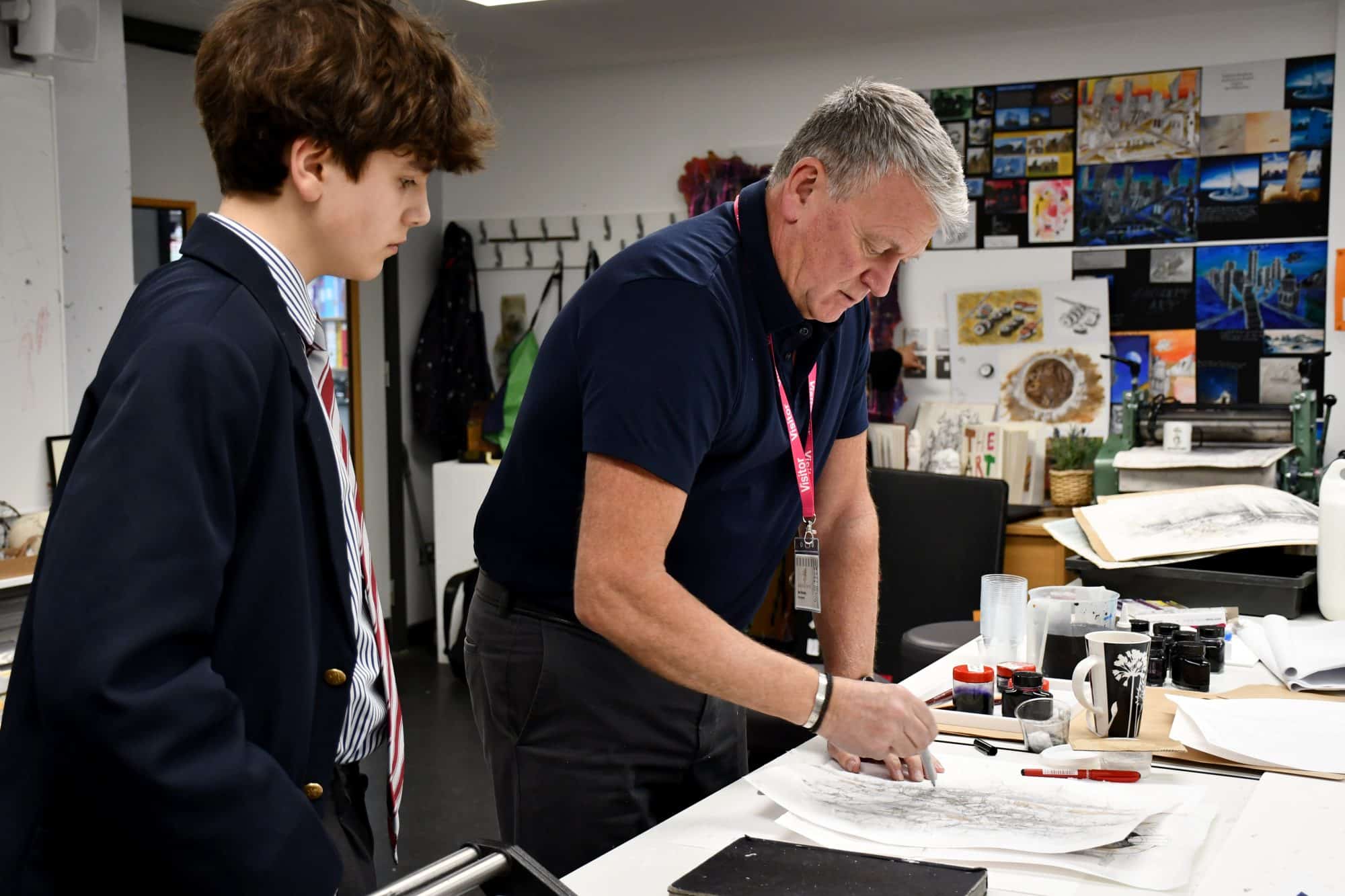
We saw this dynamic in action when we recently welcomed the contemporary British Fine Artist, Ian Murphy, into the school. Best known for his powerful tonal drawings and atmospheric mixed-media oil paintings of architectural sites, Ian is the perfect embodiment of an artist who utilises those “subtle shifts in tone” to create immense emotional impact. Having first gained recognition in 1985 as a British Young Contemporary Artist, Ian brought decades of professional expertise directly to our easels, providing our students with a masterclass in technical precision and creative vision.
Beyond visiting professionals, we place immense value on our alumni network. Many of our former students return to the department to present their university portfolios, offering current students a “peer-to-peer” bridge into higher education. This dialogue is vital; it empowers our students to make informed choices about their futures. Consequently, we are seeing a growing number of Abingdonians secure places at the world’s best institutions for Architecture, Computer Game Design, Film, Special Effects, and Fine Art.
To facilitate this level of ambition, we have cultivated a space that functions less like a classroom and more like a contemporary professional studio. This environment is anchored by a teaching team of rare depth; our three lead teachers have all previously served as Heads of Art elsewhere. They bring a collective wealth of knowledge that prepares students for the highest levels of creative endeavour. Ultimately, Art at Abingdon is defined by this high standard and sense of purpose, ensuring our students leave with both the skill and the self-belief to thrive in the creative industries.
Back to all Blogs